
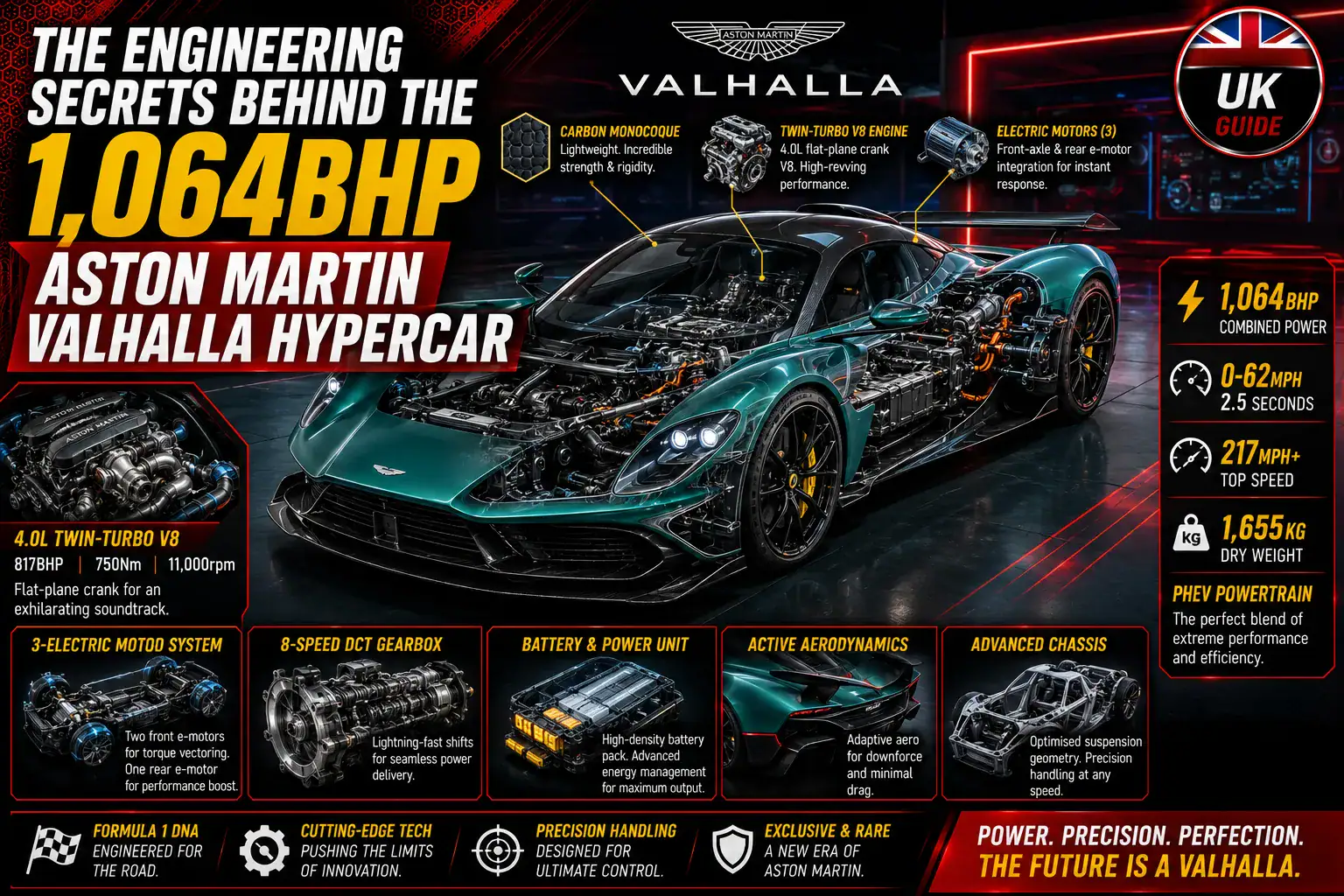
Aston Martin Valhalla engineering is about more than headline power. The car has a twin-turbo V8 with three electric motors. It also uses active wings, a carbon tub and smart control software.
The Valhalla hybrid powertrain produces 1,079PS, or about 1,064bhp. Aston Martin also claims 1,100Nm, 0–62mph in 2.5 seconds and a 217mph top speed. This guide explains how its key systems work together.
Four Power Sources, One Goal
The Aston Martin Valhalla engine is a bespoke 4.0-litre twin-turbo V8. It uses a flat-plane crank and produces 828PS. Three electric motors add another 251PS.
| Power Source | Main Function |
|---|---|
| Twin-Turbo V8 Engine | Delivers the primary drive to the rear wheels and provides high-performance combustion power |
| Twin Front Electric Motors | Power each front wheel independently for all-wheel drive, torque vectoring, and improved handling |
| Rear Electric Motor | Provides additional acceleration, regenerative braking, and assists the transmission during performance driving |
| High-Voltage Battery Pack | Stores electrical energy and supplies power to the hybrid system and electric motors |
These Aston Martin Valhalla specs only tell part of the story. The rear motor sits inside the eight-speed gearbox. It starts the V8, charges the battery and fills power gaps.
Electric torque arrives before the turbos reach full boost. This cuts the brief delay known as turbo lag. The front motors can even reverse the car. Therefore, the gearbox needs no reverse gear.
A Small Battery Built for Fast Work
The battery is not made for long electric trips. It must release and absorb energy very quickly. That keeps the Valhalla hybrid powertrain ready for repeat use.
The pack contains 560 cells. A special non-conductive fluid cools every cell. This helps the battery deliver strong power during repeated acceleration.
Its main jobs are:
- Feeding all three electric motors
- Filling gaps in V8 power
- Recovering energy under braking
- Supporting hard acceleration
Pure EV mode drives the front wheels only. Aston Martin quotes about nine miles of electric range. Top speed in this mode is limited to 80mph.
Electric Motors Also Shape the Handling
The two front motors do more than add speed. They can send different power levels to each wheel. This Valhalla torque vectoring helps the car turn and stay balanced.
There is no solid drive shaft joining both axles. Software manages the front motors, rear motor, and rear differential instead. It can move power to the wheels with the most grip.
The front motors also recover energy under braking. Large carbon-ceramic brakes provide the main stopping force. Brake-by-wire software blends both systems through one pedal.
Hidden Wings Control Airflow
The Valhalla active aerodynamics avoid a large fixed rear wing. A moving front wing sits out of sight near the front axle. The rear wing stays flat in normal road modes.
In Race mode, the rear wing rises by 255mm. It can add grip, reduce drag or work as an air brake. The wing can change position in less than half a second.
Air flowing under the car also creates grip. Rear tunnels and a diffuser pull the body towards the road. This allows the clean upper shape to remain free from a huge fixed wing.
Aston Martin claims more than 600kg of downforce from 149mph. The system holds this figure up to 217mph. Wing angles reduce as speed rises, which prevents needless extra drag.
Carbon, Suspension and Cooling Share Space
The Valhalla carbon fibre chassis forms a stiff passenger cell. Its lower tub section weighs only 74.2kg. The full car has a claimed dry weight of 1,655kg.
Pushrod front suspension places the springs inside the body. This improves airflow around the front wheels. It also creates room for the motors and cooling parts.
Cooling is central to Aston Martin Valhalla engineering. The nose holds three engine radiators, plus battery and cabin cooling parts. A roof scoop feeds cool air towards the engine and charge coolers.
Side radiators cool the engine oil and gearbox oil. Air reaches them through shaped channels inside the doors. Aston Martin says these channels improve cooler performance by 50%.
Software Is the Real Control Centre
The Valhalla’s parts must share data at high speed. Its control system connects the steering, brakes, suspension, aero and power. It watches tyre grip and each wheel’s behaviour.
This is where F1 technology in road cars becomes useful. The main lesson is not one copied racing part. It is the way every system shares data and reacts together.
Pure EV, Sport, Sport+ and Race modes change the car’s character. They adjust power delivery, steering, suspension and aero. Race mode also raises the rear wing and changes stability support.
Does It Earn Hypercar Status?
The Aston Martin Valhalla specs sit firmly in hypercar territory. It has over 1,000bhp, a carbon structure and huge downforce. Production is also limited to 999 cars.
Yet the real test is not one fast launch. The car must keep its battery cool and brakes smooth. It must also make all this power feel easy to control.
That is the strength of Aston Martin Valhalla engineering. Each part has more than one role. The motors add speed, recover energy and improve handling.
Control Matters More Than the Headline
The secret behind Aston Martin Valhalla engineering is teamwork. The V8 provides the main power and sound. Electric motors improve response, grip and balance.
The Valhalla active aerodynamics add grip only when needed. The carbon tub gives every system a firm base. Complex cooling supports repeated hard driving.
This is a clear example of F1 technology in road cars. The 1,064bhp figure gains attention. Control is what may make that power useful.
FAQs
1. How much power does the Aston Martin Valhalla have?
The Valhalla produces 1,079PS in total. That equals about 1,064bhp. Peak torque is 1,100Nm.
2. What engine is used in the Aston Martin Valhalla?
The Aston Martin Valhalla engine is a 4.0-litre twin-turbo V8. It uses a flat-plane crank. The engine alone produces 828PS.
3. How many electric motors does the Valhalla use?
The Valhalla uses three electric motors. Two drive the front wheels. One sits inside the rear gearbox.
4. How does Valhalla torque vectoring work?
Valhalla torque vectoring changes power at each front wheel. This helps the car turn and hold its line. Software adjusts the power split in real time.
5. Why does the Valhalla have a small battery?
The battery is built for power, not long range. It releases and stores energy very quickly. Strong cooling supports repeated hard use.
6. How much downforce does the Valhalla produce?
The Valhalla produces more than 600kg of downforce. It reaches this figure at about 149mph. Active wings hold it up to 217mph.
7. Does the Valhalla have active aerodynamics?
Yes, it has moving front and rear wings. The rear wing rises in Race mode. It can also act as an air brake.
8. Is the Valhalla chassis made from carbon fibre?
Yes, the Valhalla carbon fibre chassis uses a carbon passenger tub. Aluminium frames sit at the front and rear. This creates a stiff but light base.
9. What Formula 1 technology does the Valhalla use?
It uses F1-led ideas in aero and carbon work. Pushrod suspension also reflects racing practice. Aston Martin Performance Technologies helped develop the car.
10. Is the Aston Martin Valhalla a hypercar or supercar?
Aston Martin calls it a supercar. Its power and speed also meet common hypercar expectations. The final label depends on how the term is defined.